
Key Takeaways
- The right backlink analysis tool depends on the job: Ahrefs or Semrush for deep data, Pitchbox or BuzzStream for outreach, Linkody for monitoring, and Whitespark for local SEO.
- Referring domains carry more weight than total backlink count. One link from 100 different sites beats 100 links from a single source. Backlink tools help you target the most impactful ones.
- Every tool in this guide includes a competitor link gap report, which surfaces sites linking to your competitors but not to you.
- A quarterly link audit catches toxic links, broken backlinks pointing to your site, and outreach wins worth replicating.
- Monthly pricing spans $14.90 to over $500. Match the tool to the scale of your work, not to what an enterprise SEO team would buy.
What comes to mind when you think about creating a “good” link profile?
Search “What are backlinks,” and Google returns plenty of information, including the steps you can take today to improve your link profile and boost your rankings.
In the past, I’ve provided a lot of advice on building quality links, where to find the best links, and tools that can help.
Those tips can get you far, but there’s something else you need to do first: Examine your link profile.
If your website is brand new, this won’t always be a big deal. That’s because you probably don’t have links pointing to your website yet.
Conversely, if your website’s been around for a few months or longer, there’s a good chance you have some links pointing to it. Some may be good. Some may be bad. Others may not move the needle in either direction.
It’s important to understand your link profile, as this will give you a clear idea of whether you’re on the right track.
In a perfect world, you’d see nothing but high-quality, relevant links pointing to your site. That’s rarely the case in the real world, though.
Need help conducting a link audit and reviewing the results? If so, this post is for you. Below, you’ll find 14 backlink tools packed with features that shed light on your link profile.
Backlink Analysis Tools: The Basic Comparison
Pages with backlinks get more organic traffic than pages without, according to Ahrefs research.
A good backlink analysis tool tells you who links to you, who links to your competitors, and which links are helping your rankings. That way, you know where to target your outreach efforts next.
The 14 tools I cover in this guide differ in several ways. Some are all-in-one SEO suites with strong backlink modules. Others focus narrowly on a single job, such as outreach or local citations. The right pick depends on your linking strategy and your budget.
Here’s a side-by-side look at every tool covered below. Pricing reflects entry-level paid plans at the time of writing and may have shifted, so check the vendor’s site before committing.
| Tool | Best For | Standout Feature | Starting Price (Monthly) |
| Ubersuggest | Small businesses and solopreneurs | Affordable lifetime plans | $29 |
| Semrush | Agencies and in-house marketing teams | Backlink gap analysis | $139 |
| Ahrefs | SEO professionals who need deep link data | Largest live backlink index | $129 |
| BuzzSumo | Content marketers and PR teams | Content + influencer discovery | $199 |
| AIOSEO | WordPress users running on-site SEO | Native WordPress integration | $49.50/year |
| Linkody | Solo SEOs monitoring a few sites | Real-time disavow management | $14.90 |
| Cognitive SEO | Mid-sized teams cleaning toxic links | Unnatural link detection | $129.99 |
| Majestic SEO | Researchers focused purely on link metrics | Trust flow and citation Flow | $49.99 |
| SEOptimer | Agencies producing white-label audits | Customer-facing reports | $29 |
| Moz Link Explorer | Marketers who rely on domain authority (DA) | DA, page authority (PA), and spam score | $99 |
| Pitchbox | Outreach-heavy link-building teams | Automated outreach sequences | $300 |
| Whitespark | Local SEO specialists | Local citation discovery | $39 |
| Linkstant | Real-time backlink alerts (legacy) | Instant new-link notifications | $7 |
| BuzzStream | Outreach and digital PR teams | Built-in customer relationship management (CRM) for prospects | $24 |
1. Ubersuggest
Ubersuggest is my own tool, and I’ve designed it to make serious backlink analysis accessible without an enterprise budget.
You get a full backlink overview for any domain, including new and lost links, referring domains, anchor text breakdowns, and a domain authority (DA) score.
The Backlink Opportunity feature is the one I use most. Plug in two or three competitor URLs, and Ubersuggest gives you every site linking to them but not to you. That’s a ready-made outreach list.
- Pricing: Plans start at $29 per month for individuals, $49 for small teams, and $99 for agencies. Unlike most competitors, Ubersuggest offers lifetime plans.
- Best for: Solopreneurs, small business owners, and in-house marketers who want a solid backlink workflow without paying enterprise rates. If you’re new to SEO, the interface is easier to navigate than that of Ahrefs or Semrush.
- Considerations: The link index isn’t as deep as Ahrefs or Majestic, but that won’t matter as much for most small to midsizedsites, that won’t matter.
2. Semrush
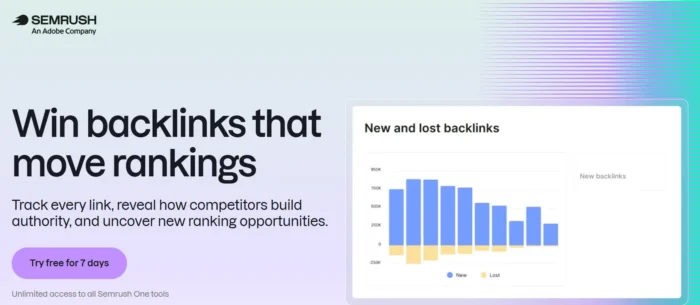
Semrush says it runs one of the largest backlink databases in the industry, with more than 43 trillion backlinks indexed. It earns its place on this list for that data depth alone.
The free Backlink Checker is good for quick checks. You can see a site’s top backlinks, Authority Score, total backlinks, referring domains, dofollow percentage, anchor text, link attributes, and whether links are new or lost. That’s useful if you just want a snapshot of your site or a competitor.
The paid tools are where Semrush gets more useful for serious backlink work.
Backlink Analytics gives you fuller backlink and referring domain data, more reports, filters, and tracking. Backlink Gap lets you compare your link profile against up to four competitors in a single view.
Semrush also includes Backlink Audit, which scores toxic links and flags candidates for the disavow file.
Both pair well with Semrush’s keyword and traffic data, which is why many agencies consolidate on this platform.
- Pricing: Semrush’s SEO + AI Search plans start with the SEO plan at $139. The Pro+ plan is $299. The Business plan ($549) adds AI visibility tools and other functionality. Discounts for annual billing are available, and Semrush also offers a seven-day free trial.
- Best for: Marketing agencies and in-house teams that need backlink data alongside full SEO, PPC, and competitive intelligence. If backlinks are one of five or six things you analyze regularly, Semrush is hard to beat.
- Considerations: Semrush’s free backlink tools are fine for quick checks. You’ll need a paid plan for serious backlink work, though.
3. Ahrefs
Ahrefs is one of the strongest backlink tools for SEOs who need more than a quick link count. Its free Backlink Checker is useful for spot checks, but its Site Explorer tool is where serious backlink work happens.
Ahrefs says its backlink index updates with fresh data every 15 minutes and includes 35 trillion external backlinks in historical records.
Site Explorer shows referring domains, backlinks, domain rating, anchor text, followed vs. nofollowed links, backlink growth, and “best by links,” which helps you find the pages attracting the most links.
Content Explorer helps surface link-worthy content ideas, while Link Intersect finds sites linking to competitors but not to you.
Ahrefs does have free access, but there’s a catch. The free account gives verified site owners limited Site Explorer access for their own websites, including backlinks, referring domains, anchors, and “best by links.” Competitor research, larger reports, Content Explorer, and more advanced link-building workflows require a paid plan.
- Pricing: Lite is $129 per month, Standard is $249, Advanced is $449, and Enterprise starts at $1,499 per month. Discounts for annual billing are available.
- Best for: SEO consultants, agencies, and in-house specialists who live on backlink data daily. Ahrefs may be overkill for someone publishing one blog post a month but invaluable for anyone running active outreach or technical SEO audits.
- Considerations: Lite works for basic backlink monitoring, but Standard is the better fit for most serious users.
4. BuzzSumo

BuzzSumo started as a content discovery tool, and that’s still its strongest trait. Its backlink data is built around content, not just domains, so you can see which articles in your niche earned the most links and where they came from.
The Content Analyzer pulls the top-shared and top-linked content for any keyword. Pair it with the influencer search, and you have a workflow for finding the writers and publications most likely to link to a similar piece on your site. The link-building use case here is digital PR, not technical backlink audits.
- Pricing: Content Creation starts at $199 per month; PR & Comms at $299; Suite at $499; and Enterprise at $999. Annual billing knocks roughly 20 percent off.
- Best for: Content marketers and PR teams who build links through earned media rather than direct outreach. If you want to know what’s working in your space and who to pitch, this is the tool.
- Considerations: It’s not a replacement for Ahrefs or Semrush on raw backlink data.
5. AIOSEO
AIOSEO (All in One SEO) is a WordPress plugin first and an SEO suite second. It’s not a dedicated backlink checker, but it can help WordPress users manage the links they control inside their own site.
Its Link Assistant shows internal links, external links, affiliate links, orphaned posts, and top domains you link to. That makes it useful for improving internal linking and cleaning up outbound links, but it won’t replace a backlink database like Ahrefs or Semrush.
Broken Link Checker is another useful add-on. It scans your content for broken links and images, then lets you address issues. The free version includes 250 internal and external link checks per month.
- Pricing: Annual plans range from $49.50 for Basic to $299.50 for Elite.
- Best for: WordPress site owners who want on-page SEO, sitemaps, and lightweight backlink data in one plugin. If you already pay for a dedicated backlink tool, AIOSEO is more of a complement than a replacement.
- Considerations: AIOSEO is not a true backlink analysis tool. Use it to manage links on your WordPress site.
6. Linkody
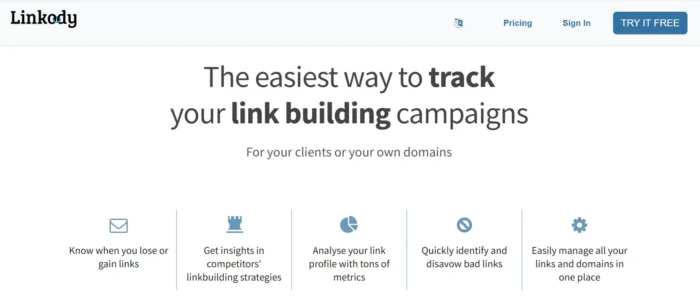
Linkody is a tool built for backlink monitoring. Add your domain, and Linkody tracks discovered links and alerts you when links go live or drop. The platform even handles marking links for disavow with a built-in file generator.
The dashboard provides backlink status, anchor text, follow/nofollow data, landing pages, Moz DA, spam score, majestic trust flow and citation flow, and other link-quality signals.
The disavow workflow is what sets Linkody apart, though. You can flag toxic links inside the dashboard and export the file for Google Search Console in a couple of clicks.
- Pricing: Webmaster starts at $14.90 per month, Advanced at $24.90, Pro at $49.90, Agency at $99.90, and Agency XL at $153.90. Free trials and discounts for annual billing are available.
- Best for: Solo SEOs, freelancers, and small agencies who want backlink monitoring and disavow management without paying for a full SEO suite. The price-to-feature ratio is the main draw.
- Considerations: Linkody is great for monitoring and managing backlinks, but it’s not as deep as some of the other tools on this list for large-scale backlink research.
7. CognitiveSEO
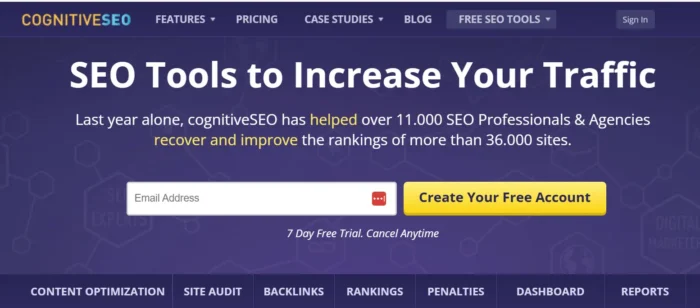
cognitiveSEO gets its reputation from the Unnatural Link Detection tool, which scores links in your profile for risk and flags candidates for disavow. If you’ve inherited a site with a messy link history or recovered from a penalty, this is the platform for you.
Beyond toxic link cleanup, you get rank tracking, content optimization, and competitive backlink analysis.
The main draw is the link-quality workflow. cognitiveSEO aggregates backlink data from trusted link databases, then crawls and analyzes links on demand, so it’s better framed as an audit and recovery tool than a pure backlink index play.
- Pricing: Starter is $129.99 per month, Premium is $199, and Elite is $499. Annual billing offers a discount. A free trial is available.
- Best for: Mid-sized teams and consultants who handle penalty recovery, link audits, or sites with risky historical link profiles.
- Considerations: cognitiveSEO is strongest for backlink cleanup and risk review. It’s less compelling if you only need everyday backlink discovery or broad SEO reporting
8. Majestic SEO
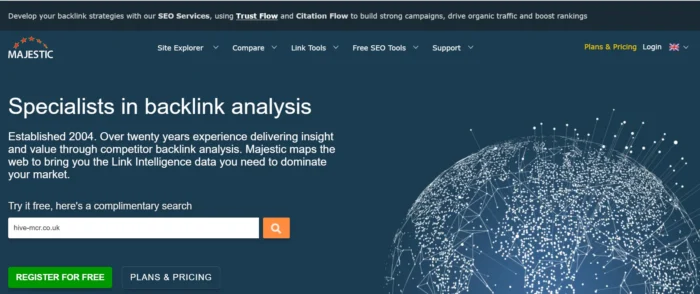
Majestic predates most of the tools on this list and remains a go-to for pure link metrics. Its proprietary metrics, trust flow and citation flow, are highly regarded across the SEO industry and shown inside other tools, like Linkody. Trust flow estimates link quality, while citation flow reflects link quantity.
Majrestic’s Site Explorer report shows referring domains, anchor text, and a topical trust flow that breaks down which niches link to you. The Link Context feature displays the surrounding paragraph for any backlink, helping you judge link quality at a glance.
- Pricing: Lite is $49.99 per month, Pro is $99.99 per month, and API access is $399.99 per month. Annual billing is available at a discount.
- Best for: SEO researchers, link prospectors, and analysts who care more about link metrics than the full SEO suite experience. Trust flow and citation flow are the reasons most people sign up.
- Considerations: Majestic is strong for backlink analysis, but it does not replace all-in-one SEO tools.
9. SEOptimer
SEOptimer is best known for white-label site audits, and its backlink research module fits into that broader reporting workflow. The dashboard pulls referring domains, anchor text, and link quality scores you can drop straight into client-facing reports.
The embeddable audit tool is a nice touch for agencies. You can install a lead-generation form on your site that runs a free backlink and SEO audit for prospects, capturing the lead.
- Pricing: DIY SEO starts at $29 per month, White Label at $39, and White Label & Embedding at $59. Annual billing discounts are available, as is a free trial.
- Best for: Small agencies and consultants who need affordable, brandable reports for clients. If you’ve been using a tool called Monitor Backlinks, that product has now been merged into the SEOptimer platform.
- Considerations: SEOptimer is stronger for audits and lead generation than deep backlink research.
10. Moz Link Explorer
Moz Link Explorer is built around domain authority, the metric many SEOs still use as a quick read on site strength. The tool provides DA, page authority (PA), spam score, and a full backlink profile with link-quality filters.
The Link Intersect report shows pages linking to your competitors but not to you, similar to Ahrefs and Semrush. Moz also tracks new and lost links over time, which helps spot outreach wins or drops in your link profile.
- Pricing: Standard starts at $99 per month, Medium at $179, and Large at $299. Annual billing is discounted, and a free trial is available. Free Moz access is useful for occasional DA checks and light backlink research, but it’s limited.
- Best for: Marketers and content teams who already work with DA and want a familiar backlink dashboard alongside keyword and rank tracking tools.
- Considerations: The link index is smaller than Ahrefs, but Moz’s data quality and reporting are reliable for everyday work.
11. Pitchbox
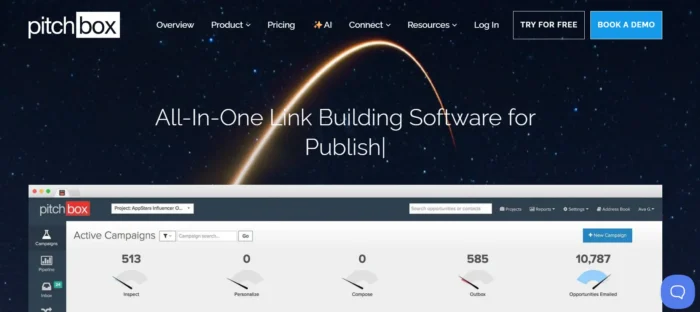
Pitchbox is an outreach platform with backlink prospecting built in. You can create prospect lists, find contacts, run outreach sequences, manage follow-ups, track replies, and monitor links from one dashboard.
Integrations with Moz, Ahrefs, Semrush, and Majestic let you filter prospects by link metrics before reaching out, shortening the time from finding a prospect to sending a personalized pitch.
- Pricing: Pro is $300 per month, Advanced is $600 monthly, and Scale is $1,200 monthly. Enterprise pricing is custom. Annual billing discounts are available, and a free trial is available.
- Best for: Agencies and in-house teams running serious outreach programs. If link building is a primary channel and you’re sending hundreds of pitches a month, Pitchbox pays for itself quickly.
- Considerations: For occasional outreach, Pitchbox is probably overkill.
12. Whitespark
Whitespark focuses on local SEO, and its backlink-adjacent work centers on citations—the mentions of your business name, address, and phone number across local directories and review sites.
The Local Citation Finder identifies high-value citation opportunities for any business or competitor. Whitespark also offers done-for-you citation building and cleanup, as well as a local rank tracker. The toolset is deliberately narrow. It’s built for local businesses, not enterprise SEO.
- Pricing: Local Citation Finder has a free starter plan. Paid plans start at $39 per month for Small Business, $49 for Specialist, $59 for Agency, and $149 for Enterprise. Annual billing is available at a discount.
- Best for: Local businesses and agencies serving multi-location clients. If you serve a geographic market and rely on Google Business Profile rankings, Whitespark is the tool for you.
- Considerations: Whitespark is not a backlink research tool in the Ahrefs or Semrush sense. Use it for citations, listings, Google Business Profile visibility, and local rank tracking.
13. Linkstant
Linkstant carved out a niche around one promise: instant alerts when a new link points to your site. While most tools poll for new backlinks once a day or once a week, Linkstant ran on near-real-time detection, enabling users to thank the linker, share the content, or correct a broken link within minutes.
- Pricing: Linkstant’s small business package is $7 per month, and its enterprise pricing is $27 per month.
- Best for: Anyone building outreach workflows around instant backlink notifications.
- Considerations: Linkstant is not a replacement for a backlink analysis platform.
14. BuzzStream
BuzzStream is an outreach customer relationship management (CRM) platform with link research baked in. You research prospects, find their contact info, send personalized pitches, and track every conversation from a single dashboard. The backlink piece comes from integration with Moz and built-in link metrics that help you qualify prospects.
The list-building features make it easy to import prospects from a Google Sheet or scrape them directly from search results. From there, the CRM handles the rest of the outreach cycle.
- Pricing: Starter is $49 per month, Growth is $174, Professional is $424, and Custom starts at $999. A free trial is available.
- Best for: Digital PR and link-building teams that prioritize relationship management over raw link data.
- Considerations: BuzzStream is best paired with a dedicated backlink tool if you need deep competitor link research or large-scale backlink audits.
Finding the Right Backlink Tool for You (and Getting the Most Out of It)
The right backlink analysis tool depends on three things: what you do with backlink data most often, how many sites you manage, and what you can spend. A solopreneur running one blog doesn’t need the same setup as a large agency.
Start with your goals and the task at hand.
- If you mostly research competitors and prospect for new links, Ahrefs or Semrush makes sense.
- If outreach is the bottleneck, Pitchbox or BuzzStream pays for itself.
- For budget-friendly monitoring and disavow management, choose Linkody or CognitiveSEO.
- Local businesses should look at Whitespark first.
Once you’ve picked a tool, get the most out of it by following a few rules.
- Audit your link profile quarterly. Look for new toxic links, broken backlinks pointing to your site, and outreach wins worth replicating.
- Track referring domains, not just total backlinks. One link from 100 domains beats 100 links from one domain. If the difference between referring domains and backlinks is fuzzy, start there.
- Pay attention to link attributes. A lot of people get hung up on dofollow vs. nofollow backlinks when creating their strategy, but these attributes don’t change much. A toxic dofollow link can hurt your rankings, while a high-quality nofollow link still drives referral traffic. Your energy is better spent on routinely auditing and maintaining your profile.
- Use competitor gap reports. Every tool in this guide offers some version of a competitor link intersect. That report alone justifies the subscription for most users.
If picking and running a backlink strategy still feels like a lot, my team handles this work for businesses every day. NP Digital builds custom link strategies, and I offer SEO consulting for businesses that want a more hands-on approach.
FAQs
What is a backlink profile?
A backlink profile is the full picture of external links pointing to your site, including referring domains, anchor text, dofollow or nofollow attributes, linking-site authority, and link velocity. A healthy profile draws from varied, authoritative sources. Backlink tools like Ubersuggest, Ahrefs, and Moz can help you pull yours in seconds.
What is a backlink analysis tool?
Backlink analysis tools help website owners analyze their website’s backlink profile. It provides information on the links pointing to their website from external sources, including the number, quality, and relevance of the links. You can use this information to identify areas for improvement in the website’s link-building strategy and improve its search engine rankings.
How to check backlinks of a website?
Open Ubersuggest, Ahrefs, Moz Link Explorer, or Semrush and run the report for your target site’s root domain. You’ll see total backlinks, referring domains, anchor distribution, top-linked pages, and a domain authority score. Focus on referring domains rather than raw link count, and watch for unnatural anchor patterns to weed out bad links. You should also study top-linked pages for you and your competitors to see which content is working for specific keywords in your industry.
How to check competitor backlinks?
Run three to five competitor domains through a tool with a link gap or link intersect report (most, if not all, of the tools in our list offer one). The report surfaces sites linking to your competitors but not to you. Sort by domain authority, then prioritize relevant high-authority targets for outreach.
Why use a backlink monitor tool?
Manual tracking can’t keep up. The average site gains and loses dozens of links each month, and Search Console won’t catch a toxic link spike or a competitor pulling ahead. A monitoring tool automatically runs alerts for new links, lost-link notifications, toxic scoring, and trend data.
Conclusion
Your link profile is one of the strongest signals Google uses to rank your site, making picking the right backlink tool an important decision for your business.
The 14 options above cover virtually every budget and use case, so the right one for you is the one that fits the work you actually do and teaches you how to build backlinks correctly. Pick the tool that matches your goals, then commit to using it regularly.
A tool you check once is wasted money. A tool you check weekly drives real results.
Recent Comments